
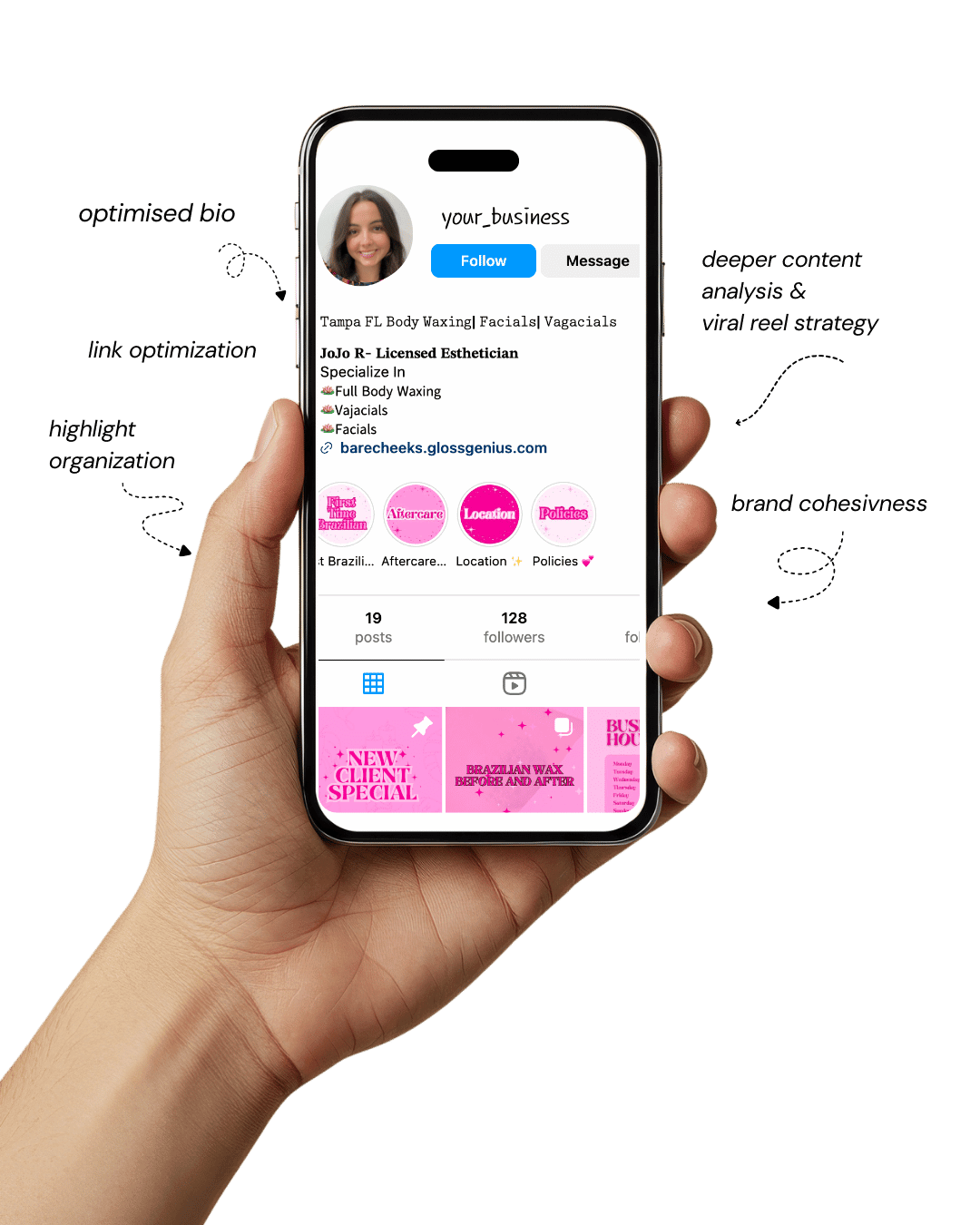
Your Instagram isn’t the problem.
The strategy is.
Get a free, honest audit of your Instagram profile — tailored for beauty, wellness & creative brands.
You’ll receive: profile fixes · content gaps · bio upgrades · content ideas.
I personally review your profile and send a clear, actionable breakdown — no AI, no templates.
Social media content is often treated like a never-ending posting chore, yet it can be one of the strongest revenue-driving tools in your business when created with intention.
Most people publish because they feel they “have to,” but conversion happens when every piece is built with strategy, psychology, and a clear understanding of the audience’s decision-making process.
When your social media content matches the way your audience thinks, chooses, and buys, your brand naturally becomes the answer they trust.
Over time, this shift turns your platforms from passive scroll spaces into active lead-generating ecosystems.
Whether you run a service-based business, a coaching brand, or an e-commerce store, the right social media content makes it easier for potential clients to picture themselves working with you — long before you pitch.
The smaller, often overlooked choices you make in your messaging, formatting, pacing, and emotional flow have a measurable impact on conversions.
By understanding what influences action online, you bypass the guesswork that keeps most brands stuck. Instead of posting and hoping, you post and guide.
You post and position. You post and convert. And by mastering the strategic layers behind effective social media content, you turn casual followers into committed buyers with significantly less effort.
Why These Strategies Matter

Creating effective social media content isn’t just about visibility — it’s about shaping perception. The moment someone views your post, their brain quietly evaluates whether your message is relevant, credible, and beneficial.
This is why strong social media content matters: it influences micro-decisions that eventually lead to a purchase.
Behind every like or scroll is a subconscious judgment, and the brands that understand this create experiences that feel tailored, engaging, and trustworthy.
Most businesses underestimate how sensitive people are to consistency, tone, clarity, and emotional resonance.
When these elements align, social media content becomes more than information — it becomes an encounter with your brand.
Prospects begin associating you with expertise, reliability, and value, even before you explicitly demonstrate it. This alignment is what shortens the buyer journey.
By applying intentional structure to your social media content, you reduce confusion, elevate your positioning, and naturally encourage action.
These strategies also future-proof your brand: no algorithm shift can erase the impact of message precision and psychological connection. When your social media content builds familiarity and certainty, followers feel guided, not sold to.
This is what creates conversion momentum — small decisions that stack until choosing you feels like the obvious step.
1. Build Content Around Real Buyer Questions
High-converting social media content starts with the questions prospects already ask themselves. People buy when they feel understood, not when they feel persuaded.
Instead of guessing what followers want, analyze conversations, comment sections, purchase objections, onboarding questions, and even failed leads.
These inputs reveal how your audience thinks, which is the foundation of powerful social media content.
The goal is to create content that mirrors someone’s internal dialogue. When a post articulates a thought they haven’t verbalized yet, your brand instantly becomes relevant.
Some brands unintentionally skip this level of detail and rely on generic topics, which is why their social media content feels replaceable.
When you address the specific concerns hiding beneath surface-level questions, your message becomes both precise and influential.
This kind of content builds trust quickly because it proves you’re paying attention and not recycling the same ideas everyone else uses online.
2. Use Micro-Stories Instead of Long Narratives
Micro-stories make social media content memorable without overwhelming the reader. These are short, vivid snapshots that highlight a moment, shift, or realization rather than a full narrative.
The brain retains information more easily when tied to emotion or imagery, which makes micro-stories powerful for conversion.
Many brands rely on long storytelling formats thinking they create depth, but attention spans on most platforms favor concise stories that get to the point fast.
When your social media content includes micro-stories, you create emotional anchors without losing momentum.
These small moments mirror real-life experiences clients recognize, which softens resistance and creates a sense of familiarity.
People often attribute clarity, competence, and creativity to brands that communicate concisely.
This subtle perception shift increases trust — making the reader more likely to move closer to your offer.
When done consistently, micro-stories make your social media content feel personal, relevant, and persuasive without sounding overly promotional.
3. Create “Choice Architecture” in Your Messaging
Choice architecture refers to how you structure decisions for your audience through your social media content. Instead of pushing for a sale directly, you guide followers through a sequence of micro-decisions that build readiness. This is used in behavioral psychology and is highly effective in marketing.
For example, you can structure posts that first help the reader self-identify a problem, then recognize the cost of ignoring it, and finally see the benefit of acting now. Each step is subtle, but together they create a clear path forward.
When social media content incorporates this kind of design, followers don’t feel pressured — they feel informed and supported.
This approach works particularly well because people rarely buy based on information alone. They buy when the next step feels simple and aligned.
Choice architecture makes your social media content function like a silent guide, helping followers move naturally toward becoming clients.
4. Pair Logic With Emotion in Every Post
Every buying decision is emotional first, then justified with logic. High-converting social media content respects this balance by addressing both sides.
If you focus only on emotions, your message can feel vague. If you use only logic, it becomes cold and forgettable. The real influence comes from combining the two seamlessly.
For instance, describe the emotional frustration your audience feels, then follow it with data, steps, or clarity. This creates resonance without losing credibility.
Brands often default to one side, but the most effective social media content bridges the gap and allows readers to “feel seen” while also feeling logically convinced.
This balance also strengthens brand positioning. When you show emotional awareness with structured insights, prospects associate your brand with maturity and expertise.
Consistently pairing emotion and logic makes your social media content more persuasive, digestible, and trustworthy — all essential ingredients for turning followers into paying clients.
5. Use Pattern Interrupts to Stop the Scroll
Pattern interrupts are subtle disruptions that immediately capture attention. Because people scroll automatically, your social media content must interrupt that autopilot mode.
This doesn’t require loud or gimmicky tactics; small changes like unexpected phrasing, uncommon angles, or visually asymmetrical layouts can create the effect.
The human brain notices contrast faster than information. When something looks or sounds slightly unfamiliar, the mind pauses to evaluate it.
This is why pattern interrupts in social media content increase engagement — they give the reader a reason to stop. Once attention is secured, your message has room to influence.
This technique is often overlooked because it seems “too simple,” yet it’s foundational in behavioral marketing. The brands that master subtle interruption earn more quality views.
When applied skillfully, pattern interrupts make your social media content more dynamic and memorable without sacrificing professionalism or depth.
6. Show the “Invisible Work” Behind Your Expertise
Most creators show outcomes, but clients buy processes. When your social media content reveals the thinking, framework, or method behind your results, followers perceive higher value.
This isn’t about sharing proprietary secrets—it’s about showing the depth clients gain from working with you.
People are more likely to invest when they understand how you think. Sharing the invisible work also differentiates you from competitors who only highlight surface-level achievements.
When your social media content makes your expertise tangible, you reduce skepticism and increase perceived reliability.
This approach also works psychologically. When the audience sees the deliberate reasoning behind your decisions, they begin trusting your approach before they ever speak to you.
By blending transparency with authority, your social media content positions you as the expert who doesn’t just produce results — you understand the mechanics behind them.
7. Use Repetition Without Sounding Repetitive
People often need multiple exposures to a concept before they remember it. Effective social media content uses structured repetition — varying the angle, format, or example while reinforcing the same core message. This creates recognition without feeling redundant.
Many brands avoid repeating themselves, fearing it will bore the audience. However, most followers don’t see every post, and even when they do, familiarity strengthens trust.
The key is to refresh the expression: different metaphors, scenarios, or emotional tones keep your social media content lively while still building a cohesive narrative.
This method also shapes your brand identity. Over time, followers associate certain ideas, phrases, or outcomes with you alone.
This association makes your offers easier to understand and more desirable. When repeated with intention, social media content becomes a strategic reinforcement tool rather than a repetitive loop.
8. Introduce Controlled Tension to Invite Engagement
Tension captures attention because the brain seeks resolution. When your social media content introduces a subtle conflict — an unexpected perspective, a challenge to a common belief, or a gap between what people want and what they do — you naturally spark curiosity.
This isn’t about being controversial for attention. It’s about presenting a friction point that leads the reader toward clarity.
Human decision-making is heavily influenced by contrast. When your social media content highlights the difference between two choices, behaviors, or results, followers become more engaged and more invested in your message.
Controlled tension also deepens the emotional impact of your content. When people feel slightly challenged, they lean in rather than scroll away.
This helps your brand shift perception and establish authority without being aggressive.
Skillful tension makes your social media content sharper, more compelling, and far more likely to convert readers into clients.
9. Use the “Future Memory” Technique
Future memory is a psychological principle where people imagine themselves experiencing a future event.
When your social media content helps followers visualize life with your solution, the brain treats that imagined scenario as partially real. This makes taking action feel familiar and less risky.
To use this effectively, guide readers into picturing the transformation, not just the outcome.
Let them mentally rehearse how your solution fits into their daily life. This deepens emotional connection and shortens the decision-making process.
Many brands only describe benefits in abstract terms. But when your social media content paints a vivid, lived-in future, the audience internalizes the value instead of analyzing it from a distance.
Future memory works because people naturally move toward what feels familiar — and your content makes the desired future feel attainable.
10. Build Authority Through Specificity
Specificity strengthens credibility faster than broad statements. The more concrete your examples, explanations, and insights, the more trustworthy your social media content becomes.
Vague claims feel generic, making your brand blend in with thousands of others saying the same thing.
For instance, instead of saying you “help businesses grow,” explain a specific behavior, mindset shift, or operational detail that contributes to that growth.
Specificity demonstrates expertise without bragging. It also gives your audience clarity about how your approach differs from what they’ve already tried.
This technique is especially effective in social media content because specificity makes posts more quotable and memorable.
Followers perceive detail as depth, which leads to stronger trust and higher conversion rates.
Over time, your precision becomes part of your brand identity, setting you apart from competitors who speak in generalities.
11. Let Readers Self-Identify Through Your Messaging
When people see themselves in your social media content, they automatically categorize your brand as relevant.
Self-identification is a powerful psychological mechanism: individuals pay more attention to messages that reflect their experiences, values, or frustrations.
You can encourage this by describing specific scenarios, symptoms, or behaviors that resonate with your ideal audience.
These descriptions help the reader realize, “This is for me,” which is exactly what shortens the gap between viewing content and becoming a client.
Many brands stay vague in an attempt to appeal to everyone, but this dilutes emotional impact. When your social media content speaks directly to a particular type of person, you attract higher-intent followers who are already aligned with your offer.
Over time, this creates stronger audience quality and more consistent conversions.
12. Use Data Without Making It Overwhelming
Data increases trust, but only when used strategically. Overloading your social media content with numbers can confuse readers or make the message feel heavy. Instead, use data to highlight contrast, validate a point, or frame a decision.
The key is to present numbers in a way the brain can process quickly. Percentages, small comparisons, or measurable before-after transformations work well. This keeps your social media content clear and persuasive without feeling academic or cluttered.
People also interpret data as competence. Even a simple statistic can reinforce authority when used well.
When paired with emotion or narrative, data becomes a grounding element that strengthens the reader’s confidence.
This blend makes your social media content feel both relatable and credible, increasing the likelihood that followers will take the next step toward becoming clients.
13. Align Your Pacing With Platform Psychology
Each platform has its own processing rhythm, and your social media content should match the way users consume information there.
Fast-paced platforms reward punchy lines and tight formatting. Slower platforms reward depth and reflection. Ignoring these natural rhythms weakens your message.
By aligning pacing with user behavior, you reduce friction and increase comprehension. Readers absorb the message more naturally, which leads to stronger engagement.
This also improves retention: when your social media content feels intuitively designed for the platform, followers feel more connected to your brand.
This approach also improves shareability. People are more likely to share content that “feels right” on the platform they’re on.
Over time, tailored pacing increases reach, trust, and conversion because the content respects how users instinctively read, think, and react.
14. Build Curiosity Loops That Create Momentum
Curiosity loops keep the reader moving through your message by presenting information in a way that requires resolution.
This technique works well in social media content because curiosity is one of the strongest psychological drivers for attention.
Start with a question, a partial insight, or a statement that hints at something deeper. Then deliver the answer in a concise, satisfying way.
When used consistently, curiosity loops train followers to stay engaged with your posts instead of skimming.
This method also increases perceived value. When your social media content continually rewards curiosity, the audience views your brand as stimulating and insightful.
This strengthens the relationship between you and your followers, making them more likely to engage, trust, and convert.
15. Transition Followers Into Buyers With Soft Calls-to-Action
Soft calls-to-action guide the reader toward the next step without feeling intrusive. Instead of direct selling, you use subtle language that feels conversational and aligned with your social media content.
This approach respects the reader’s autonomy while still creating a path to conversion.
Examples include inviting them to explore, consider, or reflect on a next step rather than commanding it. This feels more natural in feed-based environments where people resist hard selling.
Soft CTAs also reinforce trust because they make the decision feel internally motivated rather than externally pressured.
Over time, this creates a smoother transition from follower to client. When your social media content consistently connects value with approachable next steps, followers feel guided rather than sold to. This emotional ease is one of the most effective conversion tools available.
Additional Ways to Strengthen Results

Once you master these foundational strategies, additional layers can elevate your social media content even further.
One powerful approach is optimizing your posting ecosystem: align your content themes, posting consistency, and engagement habits so each element supports the others. This coherence strengthens brand memory and reduces the cognitive load for your audience.
Another enhancement is refining your pre-offer runway. Many brands introduce offers abruptly, but when your social media content gradually builds context, demand, and emotional resonance beforehand, followers approach your offers with readiness rather than hesitation.
This significantly improves conversions without requiring more aggressive selling.
It’s also valuable to audit friction points — anything that causes confusion, hesitation, or doubt.
These friction points often hide in your phrasing, visuals, or formatting. When minimized, your message flows more naturally, and readers feel more confident moving forward.
Finally, consistency in psychological structure matters. While creativity keeps your social media content fresh, structured intent behind the scenes ensures it remains effective.
When strategy and creativity work together, your platforms become ecosystems where followers convert because the entire experience feels aligned.
Final Words
Effective social media content isn’t about posting more—it’s about posting with purpose.
When your messaging is shaped by psychology, clarity, emotional resonance, and strategic structure, your platforms naturally turn into conversion machines.
The strategies above are designed to help you communicate in a way that mirrors how people think and buy, reducing the gap between curiosity and commitment.
As you apply these approaches, your audience will begin interacting with your brand differently.
Engagement feels deeper, trust forms more quickly, and followers transition into clients with less resistance.
The shift comes from understanding the invisible factors that influence decisions and using them intentionally in your social media content.
When executed well, your content doesn’t just attract attention—it builds momentum, authority, and desire. That’s what turns your online presence into a true business asset.