
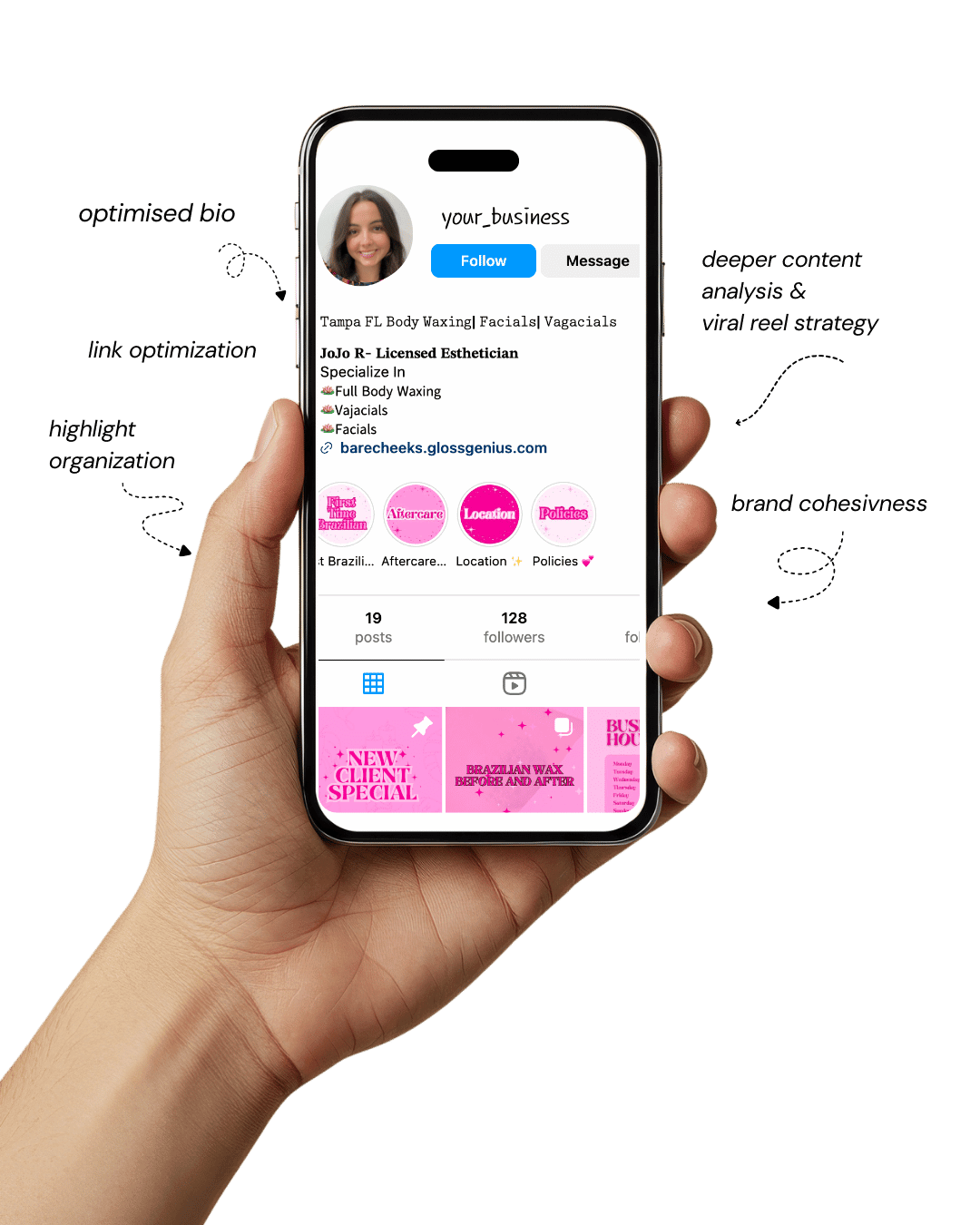
Your Instagram isn’t the problem.
The strategy is.
Get a free, honest audit of your Instagram profile — tailored for beauty, wellness & creative brands.
You’ll receive: profile fixes · content gaps · bio upgrades · content ideas.
I personally review your profile and send a clear, actionable breakdown — no AI, no templates.

In today’s digital landscape, having a strong marketing strategy and social media plan is no longer optional — it’s essential.
Whether you’re a solo entrepreneur or managing a small team, social media isn’t just about posting pretty pictures anymore.
It’s the most powerful tool to connect with your audience, build brand trust, and drive conversions.
The beauty of social media for small businesses lies in its accessibility and precision. You don’t need a massive budget to see real results — you just need the right strategy.
With a clear marketing strategy social media approach, you can position your brand where your customers already spend most of their time: scrolling, watching, and engaging.
But many small business owners struggle with consistency, targeting, and turning engagement into sales. That’s where strategy comes in.
You’re about to discover proven, easy-to-apply marketing strategy social media methods that small businesses use to attract loyal audiences and turn engagement into steady sales — without the guesswork or wasted effort.
These aren’t fluffy ideas — they’re battle-tested tactics, backed by technical insights and current trends, designed to help you make smarter, faster, and more effective moves online.
Why a Strong Social Media Marketing Strategy Matters

Before jumping into tactics, it’s important to understand why a strong marketing strategy social media foundation is so vital.
Social media is the bridge between brand awareness and customer conversion. It gives small businesses a platform to showcase expertise, build credibility, and connect emotionally with their target market — all at a fraction of traditional advertising costs.
A good marketing strategy social media plan aligns your content, tone, and timing with your audience’s behavior.
It’s not about posting more; it’s about posting smarter. By defining your goals, choosing the right platforms, and tracking metrics like engagement rates, click-throughs, and conversions, you can see exactly what’s working.
Another often overlooked benefit? Social media boosts SEO. The more your brand is shared, tagged, and mentioned, the stronger your online visibility becomes.
With clear objectives and data-driven execution, social media becomes a predictable growth engine rather than a guessing game.
For small businesses, that means more exposure, more trust, and ultimately — more sales.
1. Define Your Social Media Goals
The first step in crafting a strong marketing strategy social media plan is clarity. You can’t measure success if you don’t define what success looks like.
Set SMART goals — Specific, Measurable, Achievable, Relevant, and Time-bound. Instead of saying, “I want more followers,” say, “Increase Instagram engagement by 25% in 60 days.” This makes progress trackable.
Use analytics dashboards like Meta Insights or X Analytics to benchmark your starting point.
Your goals might include growing website traffic, increasing video views, generating leads, or improving customer support efficiency through social platforms.
2. Identify Your Ideal Audience
You can’t sell to everyone, and trying to will only dilute your message. Your marketing strategy social media should start by defining your target audience with precision.
Tools like Facebook Audience Insights, Google Analytics, and TikTok Analytics reveal key demographics — age, location, gender, interests, and behaviors.
Create a customer persona: Who are they? What problems do they face? What content do they engage with? This clarity helps you craft relevant, personalized posts that resonate deeply and convert faster.
3. Choose the Right Platforms
Not all social platforms deliver equal ROI. Tailor your marketing strategy social media efforts based on where your audience spends time.
For instance, B2B service providers thrive on LinkedIn, while product-based or visual brands perform best on Instagram and TikTok.
If your business involves tutorials or education, YouTube and Pinterest are perfect for evergreen visibility. Focus on two or three platforms where you can post consistently, rather than spreading thin across all networks.
4. Optimize Your Profiles
Your social media profile is often your brand’s first impression. Optimize it like a landing page.
Ensure your profile picture is high-resolution, your bio includes primary keywords, and your call-to-action (CTA) drives users toward your goal—like your website or online store.
A well-structured bio aligned with your marketing strategy social media plan should communicate your brand’s value in one glance.
Add your contact details, website link, and even a Linktree or Beacons page to consolidate multiple links.
5. Develop a Content Calendar
Consistency builds trust. Plan and schedule content in advance using tools like Buffer, Later, or Hootsuite.
Your calendar should balance different types of posts—educational, promotional, interactive, and community-building.
In your marketing strategy social media workflow, include important dates, campaign launches, and hashtag holidays relevant to your niche.
A structured plan saves time, maintains consistency, and improves engagement predictability.
6. Use Storytelling to Build Trust
People connect with emotions before logic. Storytelling turns a regular post into something memorable.
Share customer success stories, your business journey, or lessons learned. This humanizes your brand and creates relatability.
Integrate storytelling into every marketing strategy social media effort — use captions that evoke curiosity, show your team behind the scenes, or explain how your product solved a real problem.
Authentic stories convert far better than hard-sell content.
7. Leverage Video Marketing
Video dominates modern feeds. Platforms like Instagram Reels, TikTok, and YouTube Shorts reward consistent video content with higher visibility. Keep videos short, engaging, and mobile-optimized.
A data-backed marketing strategy social media approach involves analyzing watch times, completion rates, and retention metrics.
Add captions, brand elements, and strong hooks within the first three seconds. Video content not only increases reach but also humanizes your brand.
8. Incorporate User-Generated Content (UGC)
Encourage your customers to share content featuring your brand. UGC adds authenticity and builds community trust.
It’s one of the most effective ways to scale your marketing strategy on social media without increasing production costs.
Feature customers in your stories, create branded hashtags, or host challenges. When people see real
users loving your product, it acts as free advertising and strengthens credibility.
9. Use Paid Ads Strategically
While organic reach matters, a few well-placed paid ads can amplify results significantly. Focus on retargeting users who’ve already interacted with your brand.
Retargeting campaigns have up to 70% higher conversion rates.
In your marketing strategy social media ad setup, test different creatives, copy variations, and CTAs.
Use A/B testing on platforms like Facebook Ads Manager or Google Ads to refine performance and reduce cost per acquisition.
10. Engage, Don’t Just Post
Engagement is the algorithm’s love language. Reply to comments, ask questions, use polls, and join relevant conversations. Social media is a two-way street, and active interaction signals credibility to algorithms.
A strong marketing strategy social media framework emphasizes community management. Use tools like Sprout Social to manage replies, monitor sentiment, and ensure no message gets ignored.
11. Use Hashtags Intelligently
Hashtags are discoverability tools. A smart mix of broad and niche hashtags expands your reach without getting lost in oversaturated categories.
For example, instead of #marketing, use #smallbusinessmarketingtips.
In your marketing strategy social media plan, research hashtags using tools like Hashtagify or RiteTag to find terms that balance popularity and relevance.
Rotate them regularly to avoid being shadow-banned for repetition.
12. Analyze and Adjust
What you don’t measure, you can’t improve. Analyze your social metrics weekly—engagement rate, impressions, follower growth, and conversions.
A good marketing strategy social media system includes regular audits. Use platform analytics and Google Data Studio dashboards to visualize progress.
Identify top-performing content types and rework underperforming formats.
13. Collaborate with Micro-Influencers
Micro-influencers (with 1K–100K followers) often deliver more engagement than big-name creators because their audiences are niche and loyal.
In your marketing strategy social media campaigns, partner with influencers who align with your brand values and have authentic engagement.
Offer affiliate links or promo codes to track conversions and ROI effectively.
14. Post at the Right Times
Timing can make or break engagement. Use insights to determine when your audience is most active.
For instance, Instagram peaks midweek around lunchtime, while LinkedIn performs best on weekday mornings.
Scheduling tools can automatically post during these optimal windows as part of your marketing strategy social media routine, ensuring maximum visibility and interaction.
15. Add Strong Calls-to-Action
Every post should have a purpose. Whether it’s to visit your website, sign up for a webinar, or make a purchase, guide your audience clearly.
A high-performing marketing strategy social media framework integrates CTAs across visuals, captions, and links. Experiment with action phrases like “Get Started,” “Claim Your Offer,” or “See How It Works.”
16. Run Giveaways and Contests
Contests generate buzz and encourage followers to tag friends — expanding your organic reach. Keep the mechanics simple: follow, like, comment, or share to enter.
Incorporate them strategically into your marketing strategy social media plan.
Partner with complementary brands to reach wider audiences, and always ensure the prize resonates with your ideal customer to attract quality leads.
17. Use Social Proof and Testimonials
Trust sells. Sharing customer testimonials, reviews, and case studies helps potential buyers feel confident.
Integrate these into your marketing strategy social media calendar by turning reviews into visuals or short video snippets. Tag the customer (with permission) to increase credibility and engagement.
18. Incorporate Email Retargeting
Cross-channel integration supercharges conversions. Combine email and social media by retargeting users who engage with your posts but haven’t converted.
Platforms like Meta Pixel and Google Tag Manager allow you to track visitors, segment them, and send follow-up offers.
This hybrid marketing strategy social media and email technique builds multiple touchpoints for conversion.
19. Optimize for Mobile Users
More than 80% of social users browse via mobile devices. Slow-loading videos or poorly cropped visuals can ruin user experience.
Ensure your marketing strategy social media content is fully mobile-optimized — vertical videos, compressed images, readable captions, and clickable CTAs. Test layouts on different devices before publishing.
20. Stay Consistent with Branding
Consistency reinforces trust and recognition. Maintain uniformity across visuals, tone, and messaging.
Your marketing strategy social media guidelines should define color palettes, logo placement, brand voice, and post format.
This ensures every touchpoint feels cohesive, whether it’s a Reel, a Tweet, or a LinkedIn article.
Some Additional Steps to Boost Social Media Results

1. Experiment with Emerging Platforms
While the big players like Instagram and Facebook dominate, don’t ignore new platforms like Threads or BeReal. Early adopters often gain a loyal following fast.
2. Use AI Tools for Optimization
AI-driven tools like ChatGPT and Jasper can help brainstorm captions, analyze engagement trends, and even suggest optimal posting times for your marketing strategy social media campaigns.
3. Invest in Social Listening
Use tools like Brand24 or Mention to track how people are talking about your brand. This gives real-time insights into customer sentiment and potential PR opportunities.
4. A/B Test Content
Test different captions, visuals, and post formats to see which resonates best with your audience. Small data-backed tweaks can lead to major improvements in engagement and conversions.
5. Focus on Long-Term Community Building
Instead of chasing vanity metrics, aim to build genuine relationships. Respond authentically, create value, and stay active even when the algorithm changes.
Consistency and authenticity, backed by data and creativity, are the winning formula for any marketing strategy social media approach.
Final Words

Mastering your marketing strategy social media approach takes patience, experimentation, and commitment. The key isn’t to do everything — it’s to do the right things consistently.
Focus on creating content that resonates, engages, and converts.
Social media success doesn’t happen overnight, but with these strategies, you’ll have a clear roadmap to attract the right audience, boost brand awareness, and drive real business results.
Remember: social media isn’t just about visibility — it’s about connection.
When you connect authentically and deliver value consistently, your audience will reward you with loyalty, engagement, and sales.
So, start applying these strategies today, track your performance, refine your process, and watch your small business grow through the power of smart, well-executed social media marketing.